Podcast · 5 min · 9/18/2026
Where OpX Came From: Chris Dando and Leon Hardwick talk Building the System of Record for CI
This is the first in a series of conversations between the people building OpX, where the team explores the solutions to the problems Improvement Leaders are facing.
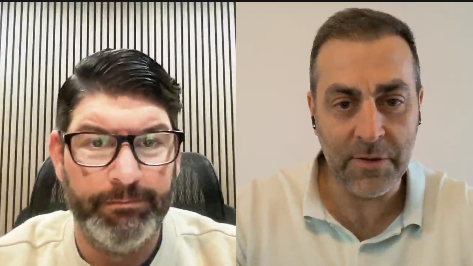
In this conversation, Leon Hardwick (CRO at OpX) and Chris Dando (Founder & CEO at OpX), trace OpX's origin story — from the coaching-led, bottom-up consulting model Reinvigoration Group built its reputation on, to the “system of record” built to give continuous improvement professionals the one thing every other function already has: a place to go, every day, to do the work and prove its impact, OpX.
Watch the full conversation below.
If the problems Leon and Chris describe sound familiar — juggling spreadsheets and PowerPoints and struggling to prove the value of improvement work — you're not alone. OpX is built to solve exactly that.
See how OpX worksThe Origin Story of OpX
Leon Hardwick — CRO, OpX (Reinvigoration Group)
Chris Dando — Founder & CEO, OpX (Reinvigoration Group)
Leon (00.06)
Hi everyone, I'm Leon from OpX. I head up the software division as part of Reinvigoration Group.
Chris (00.14)
I'm Chris Dando, group CEO of Reinvigoration Group.
Leon (00.19)
Chris, I think we probably should give this a name — something like “OpX on OpEx” or “Diary of a COO,” but we'll figure that out later. I suppose the reason we're chatting is that you've been doing a lot on social, and we've been talking about what we're up to at OpX. The question that keeps coming up is: where did this all come from? What's the origin story of OpX?
Chris (00.52)
It's a good question. Let me cast our minds back about five years — so we're in 2026 now, we're in the post-COVID world, where a lot of organisations were using our services, but digitally. We were sat there thinking about how we did what we did from a consulting point of view, which was very much coaching-led, bottom-up, sat amongst teams, building capability, putting in place ways of working that helped them improve their daily lives — and the business benefited off the back of that. But the world had changed, and there was a need for us to think differently about how we did what we did. So there were some initial conversations between a few of the team that the original ideas for OpX came from. Roll forward to now, and it's a very different product to where we set out — and we'll explore that a bit in this conversation. But really, the desire from us was to create something that was disruptive in terms of how organisations can shape, scale and sustain operational excellence, or CI, whatever you want to call it. I think we're starting to do that. I think we're really starting to do that. So that's the cliff-notes version of the original thinking, and where we came from.
Leon (02.28)
Brilliant. I think I've been around the group three and a bit years now — three and a half, I think. Being an outsider, I don't come from a CI background, so I've had a fresh lens on things and listened to folks with fresh ears. That's what triggered the OS conversation — OpX OS being the product we're talking a lot about today, which is what I'll probably cover most of in this session. My background is technology rather than CI, and in a lot of the conversations we were having, CI pros were saying things like: it's incredibly hard to justify our existence. They'd say things like, we're the only function whose entire job is to make other functions measurable, and it's really hard to be measured ourselves. They're juggling all these different products and tools and PowerPoints and spreadsheets, with no central place to do any of it. And then, fundamentally, going back to that measurement piece — not being able to justify their existence — that tends to put them in the firing line pretty quickly. That's what started the thinking about how we take what we'd originally built and augment it with things that could combat a lot of those problems. Most of the CI pros we spoke to are rich in frameworks, disciplines, and all these really good tools they can deliver impact with — but they had nowhere to go every day. Every other profession has a product they go to when they log in: finance people have Xero and Sage, designers have Canva and Adobe. CI pros didn't really have that thing they'd open up and get on with their work in. So we tried to fill that gap as quickly as possible.
Chris (04.46)
Definitely — and I think the dimension you've brought, in terms of your background and experience, has added enormous value, because you're subject-matter agnostic. Whereas I'm one of those people who's quite attached to the methodology — we always default back to that, quite keen that there's a structured sequence to make this stuff work, because that's what I've learned and it's proven to be successful. But from my time in consulting, one of the big learnings is that organisations often rely on one or two heroes to make this stuff work, and they deliver outstanding results. I remember when I worked in industry, pre-consulting, I was one of those people — if there was a problem, people would say ‘go to Chris,’ and I took great pride in that. But what I've learned in the twenty years since is that mentality only gets you a small part of the way. It's impossible to scale improvement — operational excellence — across an organisation if that's your mindset. And the challenges you brought when you came into the fold were really about scalability. You kept asking, but how would you scale that up? How would you scale that? It really challenged our thinking around the product we'd initially gone to market with. Roll forward to today, and what you've helped design absolutely answers those scalability challenges. It's still a home for the CI hero, but it's also a home for everyone in the organisation to get involved. That's where you create the groundswell of activity that ultimately gives the business what it's looking for — that's the CI culture piece.
Leon (06.44)
Yeah, and it's the culture piece — we keep coming back to the people driving these things forward. You mentioned there are a couple of heroes in a business who are instrumental in driving that stuff forward, but what if somebody gets hit by a bus? Or the other anecdote — what if somebody moves to another organisation? Those things happen all the time. So, to your point, having a system that underpins those heroes — that lets them do all the day-to-day work, measure their impact, but also record everything — that's why we've labelled the platform a ‘system of record’ for CI pros. And I think that's so crucial, not just for the measurement and the impact, but for getting what's in people's brains — the problem-solvers, the folks actually doing the work — out to the rest of the organisation so you can scale. The system won't do the gemba walk; it's not going to do the thing that people with real expertise and experience can do. But it will keep a record of those things and surface what's coming out of them. Rather than drifting around spreadsheets and manually entering details, the system of record sits underneath all of that. I think it's a step change in this space — it's as important as the people, because it gives them the tools they need not just to justify their existence, but to actually deliver measurable performance and showcase what they're capable of and what they're delivering for the rest of the business. Because the more conversations I have, the harder the story feels for the CI pro — you're delivering all this real value and impact across an organisation, but a lot of the credit goes to the functional teams doing the projects at the end of the process. So the system of record is really important for keeping track of that, and for making sure you can slot somebody else in if people move on. I think that's the bit that's super important.
Chris (09.27)
I agree. I think over the last couple of years, as we've exposed more and more CI pros to our OpX OS, they almost fall off their seat, because it's the thing they've always wanted — and we've built it. You hit on a few of the key problems there. The impact of what they do is always invisible to the people who actually matter — and by that I mean the exec and senior people. If they've invested in a large improvement programme — lots of training, running projects, changing ways of work, maybe some new tech — where does the impact of that sit at the end of the day? The honest answer is: in spreadsheets and PowerPoint decks, if at all. So when the leadership changes, or something shifts in the market and there's cost pressure, they start looking at their cost lines and go, ‘there's this expensive improvement team — what are they delivering?’ And we should be able to answer that instantly, because there's enormous value being added, but we can never answer that question properly. It's a huge problem. And there's a kind of spreadsheet graveyard that sits alongside it — everything hidden away somewhere, and nobody really knows where it is. So you're absolutely right — having one place to go, a system of record, an operating system for improvement, fundamentally designs those challenges out. And the other thing that's massively important: when you start to scale improvement, the cost of delivering it can go up almost exponentially, because how do you do it? You hire more black belts — and they cost quite a lot of money. So the challenge organisations have is how do you scale improvement while keeping the cost of delivering it sensible? A lot of that comes down to doing more with the people you already have — which is about the efficiency of how you deliver improvement, meaning you need standard ways of doing this, with automation overlaid. AI can obviously help with a lot of the analysis these days, but a lot of it's still being done manually, so you quickly start bumping up against a capacity ceiling that limits the impact. There are a number of things there that OpX OS has designed out of its system.
Leon (12.20)
It's funny, because somebody said something to me the other day that stuck: year three of a CI programme looks like year one, because nothing accumulated. But the reality is a lot accumulated — there's just no record of it. It just looks like a series of individual things people were doing across the business. The other thing that person said was, ‘are we still doing what we said we would do?’ That's super important. We talked about a couple of cases just over the last couple of days where, because there was no definitive corpus of information — no system of record for what people had agreed to do — drift happens, and nobody remembers the conversation. I think, like you said, the market's already reacting, and we're getting great responses from folks in these roles across the board. But I think it's going to become more and more important, and the market's probably going to react quite considerably over the next few months, with a lot of the work we're doing to get this out there and give people visibility of it.
Chris (13.40)
Definitely. I think the other thing that ties into the system of record — which I've never seen done well in two decades of doing this — is that where organisations do measure some impact of improvement, it's always around the larger, chunkier projects with an expert working on them. But the true value lies in the hundreds or thousands of colleagues working day to day, and those micro, incremental improvements. It might be, ‘I've saved three minutes off processing an application’ — extrapolate that over hundreds of thousands of instances, and it's significant. But because it's a micro-improvement, it's never captured. What I love about OpX OS is that it captures all of those micro-improvements in seconds, along with the people responsible for finding and solving them. All of that aggregates up together with the larger, strategic improvements, and it gives you a true sense of impact. The system of record is holistic — top to bottom — and I love that.
Leon (14.54)
It's amazing — there are lots of siloed products and tools out there that each do one thing or another in the lean and CI space more broadly. But up until now, it's been genuinely difficult, from a technology point of view, to capture unstructured data and operational reality and turn it into something digestible and understandable for everyday people. That's one thing worth flagging from a technology perspective — we've only really got to the point over the last year or so where bringing this information to life, and delivering a proper system of record, has been doable with the tech that's out there: using AI to take messy process descriptions in decks, transcripts, and spreadsheets, and turn that into machine-readable content people can actually do something with. I think that's what's really enabled this from a tech perspective — along with the ability to quickly turn around new product features and developments. We live in this crazy world where technology is so ubiquitous and easy, and I think that's played into our hands. It's probably something folks in the CI space aren't fully aware of yet, because they've never seen the options available to them in this world.
One of the things I wanted to ask you — from the meetings you're having with folks higher up in organisations, the ones who ultimately make these decisions — what's their view on technology enabling CI? Is it more that people see CI or OpEx-type projects as a people-based thing, or is there an acknowledgement that this option exists now?
Chris (17.10)
I think there's still a relatively traditional mindset when it comes to improvement and OpEx, but it's changing fast. There's probably not an individual in any professional role at the moment who isn't using some sort of AI to accelerate what they do day to day — on the smallest level, or significantly. I think there's been an inflection point in the last year where that's happened. Mindset is shifting quickly, but I still think people don't know the art of the possible with this stuff — and we're starting to show them. It's exciting and scary at the same time, based on some of the conversations I've had. But at the heart of this will always be people. If you want scale, though, it's tech and people, hand in hand. And that picture is moving quickly — I think even twelve months from now, there won't be an OpEx programme that doesn't have a tech engine like OpX OS.
Leon (18.18)
I agree. And it's funny, because we're starting to see people ask for this — not necessarily in the terminology or vernacular we use to go to market, but people are asking for the thing we've built, which is incredible really. It's testament to all the work the team have put into the product, the features, the functions, and the outcomes people get from it. So it's a funny shift at the moment, but it's really reassuring to see people recognise that there's something missing in this CI space, and that the system of record is the thing.
Chris (19.02)
So I've given you my subjective view in terms of mindsets and so on — if you imagine twelve months down the road from now, from a tech point of view, what does this look like?
Leon (19.20)
I think there's probably a reality check coming for a lot of large organisations — to say, okay, we do have a CI team, but maybe they're not scaling as quickly, or we're not seeing the outcomes as transparently as we'd like. I think there's going to be a moment where they say, okay, we need to do something more structured and underpin this with something. Whether they realise that something is a system of record, or an integration project across all their internal systems, they'll recognise within the next six to eight months that they need something to underpin this. And the art of the possible with all the tools out there today means people will always want to build first, especially in large organisations, because they've got people with expertise who can strap something together. But the cost of that is crazy in a large organisation — you're talking millions if you want to do it properly for a large enterprise. So that's the first thing people will start acknowledging, and start looking for the thing that underpins this stuff.
Going further than that, I think the art of the possible with AI models will start to help CI folks become more efficient in getting their ways of working out to people on the frontline. So whether it's OpX OS or another strapped-together solution, they'll be able to communicate, engage, and collaborate across large organisations really easily. And they'll be able to use AI to help people with the actual delivery of their projects — so, for example, someone on a manufacturing floor identifies some waste, raises a quick ‘just do it,’ or wants to create an A3 for something more complex, and the AI helps them through that, aligned to that organisation's CI academy way of working — whether that's LCS, Lean Six Sigma, or whatever. A lot of companies are talking about this and using Copilot and so on, but there's a huge amount out there about enterprises really struggling with the specific use cases — how do we actually use AI to get proper results? But I think that's one of the things folks can already tangibly see and use.
And then I think there'll be a ‘system of action.’ So you go from a system of record — understanding and recording everything, measuring what's going on based on all that information — to a system of action, which is what helps people actually deliver. Rather than a challenge going to a person, someone raises the challenge, and the AI starts to build out what needs to happen to fix that problem using a certain methodology. That becomes far more autonomous — you'll have lots of little agents helping people out on sites and in factories. And then, I suppose, the longer-term evolution is a ‘system of foresight’ — can we actually predict what might be coming, because we have all this information: the record, the actions taken, and the outcomes from those actions? If you gather all of that together, you can start to predict a bit more — what could we do to head off a trend line going in the wrong direction with a particular action or activity? I think that's the structured path over the next six, eighteen, twenty-four months. Predicting things is genuinely hard, and the more data you have, the better the prediction becomes. But logically, once you trust that the system of record is reporting the right things, and the outcomes are being reported to the right people in the right way, you can start to say: we can use this to trigger something — and maybe even predict something.
Chris (24.07)
Super interesting. That system of action — I can see that coming in very, very quickly, based on what we've built so far and the pace of the tech change going on around us. It'll be a real accelerator, particularly for large organisations with a global presence — the amount of improvement you can do with a very small team, with that thinking, is pretty immense. So, exciting for that next stage in our evolution.
Leon (24.43)
Yeah — and not just because it's our vision as an organisation to bring this to life, but because of the feedback from folks in the marketplace, and the traction and momentum we're already gathering. We've got a toe-in-the-water version of the product that folks can try out, and we'll link that up in the comments so people can access it quickly. That's exciting, isn't it, Chris? It's been a bit of a journey — made us both a little bit greyer — but it's quite nice to see it come to life now.
Chris (25.27)
It has, it has. Definitely. I was going to finish with — how do people get involved? We've made this super simple, low-friction for people to get in and see it. Tell everyone a bit about that.
Leon (25.47)
Yeah, so if everybody goes to OpX.io, you can sign up and get access to the platform quickly. We've also got the launch of MyOpX — the mobile app version of some of the tools in the platform — going live around the LCS conference date, so we'll post that too. There are two versions: a full enterprise platform, and a smaller, individual version for CI pros to do tasks and collaborate with team members. There's a whole bunch of templates already built in. We've opened it up, so folks can get access and start using it pretty much straight away — it's all at the OpX website, opx.io.
Chris (26.34)
Good, good. Well, look, we'll wrap our first conversation up there. We do need to think of a good name for it — I can definitely see us going viral on YouTube, TikTok, and all the rest of it. Certainly LinkedIn. Leon, thanks — good chat. Great to set the context for where we are today and what brought us to this point. Looking forward to the next one.
Leon (26.55)
Nice one, Chris — thanks, man.
Chris (26.59)
Okay, cheers.
Building the system is one thing. Scaling it is another. OpX gives CI pros the system of record to prove the impact they're already delivering.
Sign up at opx.io