Podcast · 5 min · 9/18/2026
OpX Founder Chris Dando Talks to Rob Regan on Scaling CI
Rob Regan has spent 25 years scaling CI across complex organisations. In this episode, he shares what works, what doesn't, and what most leaders get wrong.
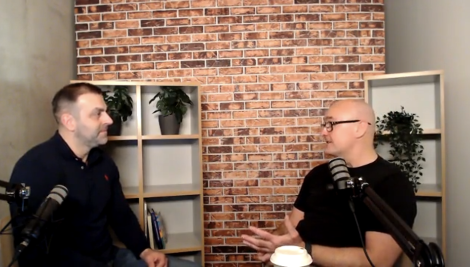
OpX founder Chris Dando hosts Scaling CI, a podcast for improvement leaders who want honest conversations about what it actually takes to build a CI programme that lasts.
In this episode, Chris talks to Rob Regan, a continuous improvement leader with 25 years of experience across manufacturing, financial services, and complex operational environments, about what breaks when CI tries to scale and what the programmes that stick do differently.
Watch the full episode below.
Prefer to read? The full transcript is below, or you can read our article, “Lessons from a CI leader on scaling continuous improvement”, which covers the themes discussed in more depth.
If the patterns Rob and Chris describe sound familiar, you're not alone. OpX is built for CI leaders who know what good looks like but need the infrastructure to make it stick.
Scaling CI Podcast: Why Continuous Improvement Fails at Scale
Host: Chris Dando
Guest: Rob Regan
Chris (00.44)
Okay, let's dive in. So I'm really delighted to welcome Rob Regan to the podcast today, Scaling CI. I first met Rob 22 years ago in a former business that I worked with, that Rob also worked with, and Rob eventually hired me in that business. So that's kind of how we got to know each other. And we've worked together I think three times since in other guises. So Rob, tell us about you — give us your kind of career history, thinking about improvement and operations. Where have you worked and what have you been involved in?
Rob (01.32):
Yeah, thanks for having me on, Chris. It's great to catch up. Didn't realise it was that long, but yeah, we're all getting on a bit now, I guess. My career — I always describe continuous improvement as being the connective tissue, if you like, between my really early days. I've just started — you'll laugh — I've just started writing a book and it's about building sites and boardrooms. My very early career was spent on building sites and factories, and my first foray into Six Sigma as it was then — continuous improvement, or Lean even before — was in Sony in Bridgend in '96, '97, where that was the first place I met Emma Griffiths and some of the other boys you know. And from that moment on, really, that became the connective tissue and that's almost been the path through everything I've ever done. So, Japanese culture, very continuous improvement led. And then I did a bit of consulting in the early days, bit of work for the Welsh Development Agency, and then up into Lloyds where we met in 2004, I think — yeah, so your maths is about right. I went in as a head of continuous improvement and built a CI capability from scratch, brought a load of people in from manufacturing and engineering, and started working with people in the business like yourself and others. And yeah, very rapid then. Lloyds was the kind of accelerated growth for me where I went from the CI role into running the director consumer P&L, which was a hundred million P&L, and I was pretty much still a young kid in my eyes at that point, so it was rapid. But then everything I've done since then has always been about how do you build businesses and improve businesses with CI at the core? So as I've moved through and become more senior, I've got more involved in complex businesses. That's where we've worked together — every time I went somewhere new, going back to the core foundations of building a CI capability was how I replicated early successes.
Chris (03.32):
Yeah, brilliant. So 25 years or so in improvement. You've seen a lot. So we're going to chat about some of the things that you've seen — some of the things that have gone well, some of the things that probably haven't. To kick that off, I'm really interested to get your views on how do you scale improvement without losing the essence of what it is? So organisations typically start small with a small amount of expertise and they get some early wins — they deliver some projects. But then when we try to make this thing grow, particularly across large organisations, it often stutters or fails. So what have you learned around scaling CI? What works, what doesn't?
Rob (04.16):
So I think we've definitely had examples — even stuff we've done together — examples of where it's gone pretty well, and definitely examples of where I didn't get it right in different organisations. And I've tried to kind of reflect on what are the differences between when it works and when it doesn't. And there's a few things, and every time you do this, circumstances are slightly different. But for me, there's probably maybe two or three really key ingredients. And I think the most important one is — I describe it as strategic or leadership incongruence. I've had examples where you've had CEOs or senior execs that talk with real passion and conviction about the need for continuous improvement, and that's where that involvement ends. It's the classic words and deeds, and for me that's probably one of the key culture killers. So one of the primary ingredients is absolute relentless buy-in from the top. And what does that look like really? It's when they go to the work. It's a passion of mine, I know you share it. If you're in a contact centre environment, go and put a headset on, go and talk to frontline colleagues, because that's where all the value is. If you're in a factory, as many of us were, go to the work, go to the shop floor, talk to the people doing the work. And I think too often, the words and the deeds are misaligned. So that's probably the most fundamental thing. The second thing I've found in every environment I've worked in is trust — or lack of. And it's kind of linked to the first; these things are all related, part of the ecosystem. Often when you run a continuous improvement programme there's a core driver, and too often it'll be described as creating capacity for growth, or it'll try and dress up what you're doing as a positive, optimistic outlook. But almost inevitably, in most environments, there is a need to take costs out of a business. And I think by not getting that messaging right up front, it leads to mistrust straight away — you lose the audience, you lose the front line. And then the final piece is trust top to bottom — leadership at the very top not taking your kind of middle management on the journey with you. If you don't get buy-in from your senior leaders and your middle leaders, you're doomed, because they're taking a lot of flak from the guys at the front line and trying to manage up that everything's great. The leaders at the very top are not going to the work. So you end up with this ecosystem of mistrust. Those are probably two or three of the really symptomatic issues I've experienced.
Chris (06.57):
Good examples. And on that senior leadership one specifically — you used the term "words and deeds". I've seen senior people talk the talk, but actually when you scratch the surface they don't really understand. You're smiling, so I'm sure you can think of many examples — and probably a lot of people watching this that are saying that's me and you, Chris. But I think, yes, of course you've got to be able to give the right narrative, but if you don't truly understand it, how can you truly support it? Would you share that view?
Rob (07.37):
Yeah, I'm probably quite extreme on that view. I love what Stuart Machin's been doing at Marks & Spencer's — get out on the shop floor, stack the shelves, everybody in his leadership team has to spend time on the shop floor. I've come from that background. That was my kind of apprenticeship, if you like, in Sony working for the Japanese. It's something they did brilliantly. So I'm probably an extreme version. I think a lot of people throughout my career have told me, you're too technical, you're too into the detail. You're a CEO now — that's for other people to do. I don't agree. The engineer in me wants to understand, but I also think that helps build credibility. Of course there's some sense in the view that you can't do all the things you would want to do because you've got other things to be doing, but for me there's nothing more strategic in a business than understanding how your business works and learning how to improve it. The "walk the walk" is really important. So I'm probably a little bit on one end of the spectrum — my natural bias is: understand the work, go to the work, find the data, go to the data, go to the people that understand, break through that permafrost of middle management and role model behaviours by asking "show me, don't tell me." I'm definitely an advocate of senior leaders — whether that's exec, senior leaders or frontline managers — you really need to understand it. In the same way as we don't do a great job in many environments of training people how to be leaders — we take the best call centre operator and put them into frontline leader roles, and rarely do we really invest in them as leaders — I think this is a fundamental leadership capability. Learning how to manage the work, rather than just manage the people — or to do both, actually — is critical. So yeah, I'm probably slightly biased, Chris.
Chris (09.36):
Good point. I want to come back to that permafrost — that middle layer — in a second. Just staying with the folks at the top for now. We talk about improvement being set within strategy, and what I kind of mean by that is — again, my observation over the years is that it's often not considered as part of a strategic narrative. It's often seen as something that just gets done over there, without real understanding that it's often a massive enabler of delivering some big strategic goals. What's your experience of that and what's your view?
Rob (10.28):
Yeah, so we've probably shared some good experience on that. If I think of strategy deployment — and again it doesn't matter what language you're wrapping it in — it's about absolute clarity of strategic focus. At the most macro level: vision, mission, purpose, whatever language people want to use, really clear and compelling understanding of what measures you're trying to drive. Fairly fundamental in any business, but then trying to link that directly to the work being done. You and I have seen loads of examples where companies will go off on big strategic investments — often tech — with no understanding at all of how the work actually works. So for me, it starts with clarity of purpose, clarity of vision, clarity of metrics, simplify your strategic aims, and then cause and effect is a passion of mine. Making sure you understand — before you start spending on tech or significant investment programmes — how well do you understand the relationship between the work and the strategy you're trying to deliver? I was once asked a question in an interview about strategy, and clearly I didn't answer it very well because I didn't get the job. But I think sometimes when you use the word "strategy" or "strategic", people think that means complex and long. Whereas I don't believe that. I think some of the most strategically enhancing parts of your business are super simple ideas where you bring absolute clarity and have connection between the work and the outcome you're trying to drive. And I think that's it, in a nutshell — clarity, and then how do we align everything that we do to that. Simple in principle, but often not done well.
Chris (11.58):
We did some work together fairly recently, and I remember — I'll use that example because it's a bit more recent — going into LV= General Insurance back in whatever that was, 2010, 2012, something like that. I arrived, and everybody had looked at the CV before I arrived. I'd gone in as CEO, and somebody came to me with a big list of "we do continuous improvement here," knowing from my background I was CI-driven, and they had a list of something like 72 in-flight initiatives. I asked, what benefits have you driven as a consequence of all that? And they totalled up all the 0.02s and 0.1s and it added up to like minus five. So it was a great example where brilliant endeavour, brilliant people working really hard, but without real clarity of what they were trying to achieve. And as you'd expect, we kind of started again. It's a great example of where sometimes people of the best endeavour don't apply themselves to fewer things better.
Rob (12.57):
Yeah, and this is one of the reasons I think I see lots of improvement teams coming under the microscope at times when businesses are looking to sharpen their pencil a bit. And it's always struck me as completely counterintuitive. But when you see how improvement is run — when you understand that often there isn't a strategic link, there isn't a consistent approach, and there isn't visibility of the impact — it's quite easy to see why they're suddenly seen as a cost centre.
Chris (13.38):
Yeah, and I probably have that same example. We managed to get some really, really good people in — and we built momentum really quickly. But in those first early days, the people we'd hired were, in the context of that environment, pretty expensive. I'd made some significant interventions in the leadership team quite quickly — something I haven't replicated elsewhere, but it was needed. Brought a whole load of people in, so immediately you've set them up to fail because everybody's throwing rocks at this new group. And it was really tense, because we had a lot of pressure. At the time, some of the people we brought in were the most expensive people we had in the business, and it just takes time to get momentum. So the first month, six weeks, eight weeks, ten weeks — all the CEO at the time could see was this significant weekly and monthly cost. And then within about six months, we had absolutely transformed — not only me, but certainly people like Emma Griffiths, Paul McCarrigle, Craig Brown, Ian Edwards — they completely transformed the claims cost base at LV=, to a level that had never been seen in the history of the business. We saw combined operating ratios drop. Those four or five people — Andy Carter and others — paid for in spades, over and over again in the end. So I understand why that pressure happens, but the value came through.
Rob (14.57):
I was very fortunate to attract really good people really quickly. But I've also seen where consultancies have come in, we haven't done the top-down piece, we haven't engaged the middle layer, we haven't engaged the frontline leaders, and with some blended day rates of two or three thousand a day, all of a sudden that's a lot of cash — and you haven't laid the groundwork and you're not getting the value out. So I've seen the extremes. But for me, you've really got to make sure you've got that buy-in for those early periods. Once the money starts coming through — show me the money — once you see value, whether it's top line or bottom line, it becomes self-fulfilling. It's that period — and it's different in different businesses depending on how much groundwork's been done — the time from investment to value, the big drop-off. The longer that period between the upfront investment and the first bit of jam, the harder it is. So yeah, I think you've got to try and show value early if possible. Even if it takes you backwards a little bit, you might want to do some quick wins, some tactical stuff, just to show that there's value. And sometimes you might have to go back then and repair some of the damage you might do with those quick wins.
Chris (16.37):
Interesting. Let's talk a little bit about value — evidence and the impact of improvement as a build on that. Where have you seen scenarios where the true impact is somewhat hidden, and that creates confusion as to the value of improvement? It's not always crystal clear, particularly if you've not set up that process to surface the value. So have you come across that — either where you've been challenged because the value's hidden, or where you've put something in place to make sure that challenge doesn't happen?
Rob (17.17):
Yeah, probably the first point: definition of value is quite fluid. You've got to be really clear — are we going after quick wins or are we building capability for the long term? I'm not saying either is right, it's not binary, but you've got to be clear on which it is. So I've been involved in some programmes where a year in there's no value — and that doesn't really work. And I've gone into some where they've gone after the quick wins and destroyed the culture really quickly. So it's got to be situational. The messaging top to bottom in the organisation around which of those it is, or what blend, is absolutely crucial. And I think if you're looking to build long-term, sustainable, embedded capability — and you're prepared to invest, as you would in other investments in culture or leadership development — so long as you're clear upfront that this is for the long term, you can go slower, take more people with you, build capability, develop leaders along the way. For me, that is the most sustaining approach. But if you haven't got a board, an exec team, or a senior leadership team that are really bought into the long term, it'll drift off really quickly, lose momentum, and succumb to what you've described.
Chris (18.53):
Yeah, exactly. Let's talk about the impact piece again, but right down at the front line. CI is a massive enabler for people to develop. I remember when I first learned it and I was like, my God, all these things I've been doing for years and years were wrong — and it wasn't on me, it was because that's what I was taught. But the penny dropped, and then you can't look another way. And one of the reasons why I went on my journey as a professional was to help other people have that moment. So how do you get frontline colleagues, en masse, engaged in improvement — seeing the impact of their suggestions or their problem-solving? How do you create that swell that ultimately is what you need to do to change a culture? It can't just be top down — you've got to affect the masses as well.
Rob (19.58):
Your first point made me smile. I often use you as an example — and myself — for some people to describe that literally this is the thing that helped me go from working on a building site to being CEO of a reasonably sized company. For some people that's really engaging. And the other reason I smiled was when you said "once you've seen it, you can't unsee it." We used to call it the Muda goggles. Once you put the Muda goggles on — I always talk about walking into a motorway service station and if the beans and the jacket potatoes are not close to each other, you immediately try to reorganise the food in the layout. So I think: talking to people about how this is something that will help them progress and develop over time, and that it'll make their life easier — hooking into different motivators, because we all have slightly different motivations — is really important. But most fundamentally, and you've touched on it: solve the problems that are important to them. There was an example in a recent deployment where a load of the frontline colleagues had been building lists and lists of issues that go nowhere. There was a conversation with a really senior exec and it was like, here's a list of 150 things — if we could just fix 10 of them, the level of engagement we'll get from frontline colleagues will go through the roof. But the response was, we're not going to do that, we're going to go and build this fancy app and this website. And that's back to our first point — incongruence. Really really important: spend some money fixing stuff that matters to the frontline colleagues. The minute they can see you're doing stuff that makes their life better, they're 100% behind you. The minute they see you saying the right things and doing the wrong things — game over, trust gone.
Chris (22.40):
Okay, I just want to talk a little bit about what breaks when CI grows arms and legs. So you work hard to get some early wins, you get people pricking their ears and going, actually, this is worth my attention — at all layers of the organisation. So we want to do more of it. From your experience, when we really start to try and move faster and broader, what breaks?
Rob (23.07):
Yeah, a few things. I'll start philosophically. Having been one of the really early adopters in the UK — '96, '97, sent to the States for my training — it was fairly heavy on stats and tools. We were all accused of being tool heads. But what I would say, going back to '96 and jumping forward to now, is that it's often been dumbed down. Often for good reason, but sometimes it gets dumbed down too much. It links to your point around people not really understanding. So one of the challenges when you scale is there's such a desire to go at pace and to do mass that you lose quality. Like with any learning, if you're not creating the coaching support and backup, if you're just doing training — and we've seen examples of a thousand yellow belts trained up across frontline people — the quality just isn't there. So I think quality is absolutely crucial and there has to be some evidence-based assessment. We've seen tools where you go in and do a maturity assessment, and the principle should be: not stepping away until you've reached the next stage of maturity. Too often it's like "that group are done, move on." You're not giving the people you've trained a chance — you're leaving them to it, not getting behind them, not enough coaching or support. Someone once said it's like bending a piece of card: you bend the card, you let it go, and it springs back. It's quite easy if they're not getting support to go back to the old ways, because the old ways are comfortable. So making sure you don't move too fast, making sure the quality of the intervention — not just training, but coaching, support, follow-up — and making sure there's some tangible, measurable improvement in maturity, not just in benefit and value. Is the huddle working really well? Is visual management good? Have they got good metrics aligned to purpose? Move on to the next phase only once you've got real critical mass in each area. The ones we've seen fail go very broad very quickly, and then you also just completely lose track of measurement and value. All of a sudden you've got a thousand things going on across an organisation, little micro-benefits everywhere, it all gets completely lost — and then all of a sudden you've got a load of busy fools, in some people's eyes, away from their actual work, doing CI, and you get: "if you just got back on the phone, we wouldn't have these problems." You lose hearts and minds again.
Chris (26.06):
Interesting. So just on that last point — lots of people doing CI. That's interesting because you get two quite opposing views. One view is that you're off doing CI. Another view is: actually, our job is to improve the work. And then the follow-up question around lots of people doing lots of things — does your experience suggest there's a coordination challenge when you start to get scale? It's easy when you've got 20 or 50 people doing some improvement, but how do we coordinate what's going on, make sure we're measuring the impact, people are doing the right things, people are getting the support they need — the more you scale, the harder that becomes, seemingly. What's your view?
Rob (27.05):
Absolutely. It's the same challenge as — if you've got 300 clubs across Wales, how do you maintain coaching standards in all 300 clubs? What's the connective tissue that means everybody broadly does the same thing? How do you enable clubs to operate better? And it's the same in a big organisation. We've worked in some where you've got everyone in one building, and we've worked in some where you might have a dozen sites, multi-geography, across the globe, people hybrid working. So I think there's that challenge of: how do you maintain quality, how do you track value, how do you track progress? Particularly, this is where for the senior and middle leaders it can get pretty lonely, because all the support's gone. We've told them, well, this is your job now — but we haven't taken anything away. We expect them to do all the non-value-add stuff they've always been doing, and we're asking them to do all this other stuff on top. So I think it's working out how do you create that community, how do you create that connective tissue so leaders don't feel abandoned and frontline colleagues feel they're being listened to? And I think those that have been the most successful in all the different deployments we've been involved in — when you've got frontline leaders, middle managers, and senior leaders in a given vertical who all get it — that becomes the model. The question is, how do you then replicate it? Because like culture, CI culture — whatever you want to describe it as — how do you make sure quality, control, consistency doesn't become a bureaucratic nonsense, which we've seen time and time again?
Chris (29.17):
You started in electronics, so obviously all of this stuff came out of manufacturing and the Japanese organisations. You learnt that, you moved into services and spent the last 20-odd years in services. They're two different beasts, aren't they? I've not seen many good examples of where improvement thinking and practice is actually part of the fabric of a service business. Why is that?
Rob (29.47):
I've got some provocative views on this. Somebody used these words once and they kind of stuck with me — it was a phrase about "engineers and actors." What I found fascinating in some of the FS businesses I've worked in is how innumerate they were. Ironically, you've got hundreds of metrics, but at the most macro level, people didn't understand the basics about common cause and special cause variation — they were permanently responding to single points of data, didn't understand trends, didn't understand control charts. Coming from manufacturing, as an engineer, some of those things are taught as first principles. Even in Sony, where the Japanese culture was built on continuous improvement and optimisation, you learn so much. But even then, having done all the lean stuff, it was probably two years into our Six Sigma journey that Dean Williams — who you know — took three years' worth of data and plotted it on a control chart. And basically our entire efforts over all that time had had no impact. It was noise. You'd go in, work on yesterday's top defect, come in tomorrow and it wasn't top, and you'd think "great" — but it wouldn't have been top anyway. So people don't use data, or they don't use it effectively. Having worked in places like insurance, you get a really good actuary who absolutely gets it and nails it, and you can use them to help you influence others. Data — and numeracy, and the practical applications of basic tools — I think is one of the biggest differences between manufacturing and service.
Chris (32.16):
Again, from my experience — the margins are far tighter in manufacturing, so you have to be all over the finest details in order to survive, let alone optimise. Whereas in services, we accept huge amounts of variation. It's a lot more difficult to squeeze that — obviously you can to a certain extent, but we're all humans, there's inherent variation, and the margins are far higher. So the focus hasn't needed to be there in the same way. If you did the taxi driver test — I remember doing this years ago with insurance — you'd ask people, how much does an insurance company make, pennies in the pound? And people would be saying 50p in the pound. And the reality is most insurance companies at the time were operating at two, three, four, five pennies in the pound. So some service sectors are definitely higher margin, I agree, but others — I just don't think there was the mindset. I think it took really brave people. Where it bled across was when you had people like Jack Welch and others who took the GE mindset into the service sector. I think particularly in FS — banking, insurance — people generally came through a finance or business school background where some of those first principles around data and variation weren't really a concept in leadership thinking. I've not seen many that are brilliant, but often it's when you have somebody in a reasonably senior position — COO, CFO, or a CEO — who really gets it, and then goes and hires great people to do it on their behalf. That's when it works really well. But I think in the main it's still very dumbed down in FS versus some of the best manufacturers.
Chris (34.57):
Okay, so I want to talk about good improvement and how much of that is down to having really good individuals versus having a system that underpins the results of improvement — or a crossover.
Rob (35.14):
That's primed for the Deming statement, isn't it? A bad system will beat a good person every time. The thing that really struck me, having done lots of learning over many years, was watching the Deming Red Beads exercise. Once you've seen it, you can't unsee it. Basically, what it shows you is this point around common cause, special cause variation, and particularly it rubbished the Jack Welch approach of firing the bottom 5% — completely blew apart that school of thought. And don't forget, Deming was around in the '50s. So for me, understanding the difference between common cause and special cause variation is absolutely crucial. I would say the system. And there are probably people shouting at this now — I've had that debate with people recently and they're like "yeah, but..." — every time we say that. My "but" is that the system is often created by really senior leaders. So as I've become more senior over time, I've probably adapted my thinking. If I'm having a debate with somebody like Deb Watkins now when we're talking about performance, and I might moan about somebody, she says, "but it's always the system" — but they are the people creating the system. I haven't really worked out how to describe that well, but there's definitely something in the idea that your job as a leader — depending on where you are in the organisation — is to create the system. So what I struggle with is when people say "they" or "them — they won't let us do this." Well, who's "they"? I do think there's an interesting dynamic at some point in the leadership transitions where the system is a function of poor leadership.
Chris (37.19):
A hundred percent. And I think that's why it is so critical to make sure — and it's one of your first points — that your senior leaders really do get it and really do understand it beyond a superficial level. Okay, so a couple of closing questions. From your experience, what's the most common mistake that an organisation makes when trying to scale CI?
Rob (38.03):
Not being honest about why CI is there. Why are we doing this? The Simon Sinek "why" — why is this important? Tactical over strategic, starting at the bottom without having a clear link to strategy. You get scattergun improvement and no way of showing impact. And lack of sustainable infrastructure — whether that be measurements, learning capabilities, benefits tracking, coaching, development — you have to create the ecosystem to sustain. Those would probably be three big ones.
Chris (38.29):
Let's talk a little bit more about that improvement infrastructure. There are lots of things needed to allow improvement to scale. What do you think are some of the most important parts?
Rob (38.59):
I definitely think something about maintaining support for leaders for a longer period of time. Even if it's something that means if they're struggling, they've got somebody to reach out to — whether that's some internal or external mentorship programme or coach development. In the same way as leadership development programmes give you a coach, how do you make sure that over a longer period of time there's affordable, sustainable support for leaders? That's pretty crucial. Definitely something around tracking activity and cost-benefit analysis — the impact of what's going on. A mechanism to make sure, without a load of bureaucracy, you can measure value so that when the doubters come in — because CEOs and execs change so often — something that shows constant return on investment is pretty key. And then there's got to be something for me around sustainable engagement and communication. How do you celebrate the wins? Too often you do that really well upfront — the town halls, the playbacks after doing improvement waves, the frontline come along and present. The first one, you've got the whole exec there. The second one, there's four there. The third one, there's two. And by the fifth wave, you might have one senior leader there because their calendar is full of other stuff. Maintaining that consistency of leadership support and presence throughout — and that, to your earlier point — it has to be part of the day job, not seen as a project or programme.
Chris (40.52):
Rob, thank you so much. Really insightful. Bit of humour littered in there as I thought there would be. Appreciate you coming on today and sharing your experiences.
Rob (40.52):
Thanks for having me on, Chris, any time. Always good to chat.
Scaling CI is one thing. Sustaining it is another. OPX gives improvement leaders the operating system to do both.