
Blog · 5 min · 11/4/2026
Continuous Improvement Engagement: Why People Stop Sharing Ideas (and How to Win Them Back)
Discover why continuous improvement engagement drops and how closing the feedback loop can rebuild trust, encourage ideas and drive lasting improvements.
You can ask people for ideas. You can’t expect them to keep offering them if nothing happens afterwards.
I posted that on LinkedIn a few weeks ago and it struck a nerve. Thousands of people reacted, hundreds commented, and it was reshared well beyond my own network with well over half a million people reading the post. The comments told me something I already suspected after 20 years of helping organisations improve: falling continuous improvement engagement is rarely a people problem. It’s what happens to the ideas after people share them.
This post pulls together what I wrote, what came back in the comments, and what I think leaders should do about it.
Blog by Chris Dando, CEO and Founder of OpX.
The pattern behind low continuous improvement engagement
I’ve seen a pattern happen time and time again through countless organisations. Someone on the frontline spots a problem and suggests a change. They sometimes tell their manager about it, sometimes are asked to fill in a form, but ultimately hear nothing.
A few weeks later, leadership is asking how to improve continuous improvement engagement, and so another campaign goes out with a call for ideas. However, fewer people respond.
Most organisations treat this as a motivation issue, but I don’t think it is. People haven’t run out of ideas. Instead, they’ve stopped believing anything will happen to them.
So before asking for more, I’d start by looking at what happened to the ideas people already gave us and ask a few questions: Who reviewed them? Who made a decision? Did anyone explain what happened next? Or at the most basic level, give some element of feedback to the person who just wanted to make things better?
Why employees stop suggesting improvements
The comments made on my original post, and again on the repost by Toyota Production System & Lean Hub were a useful snapshot of what people experience. A few themes came up again and again.
Ideas disappear into a process
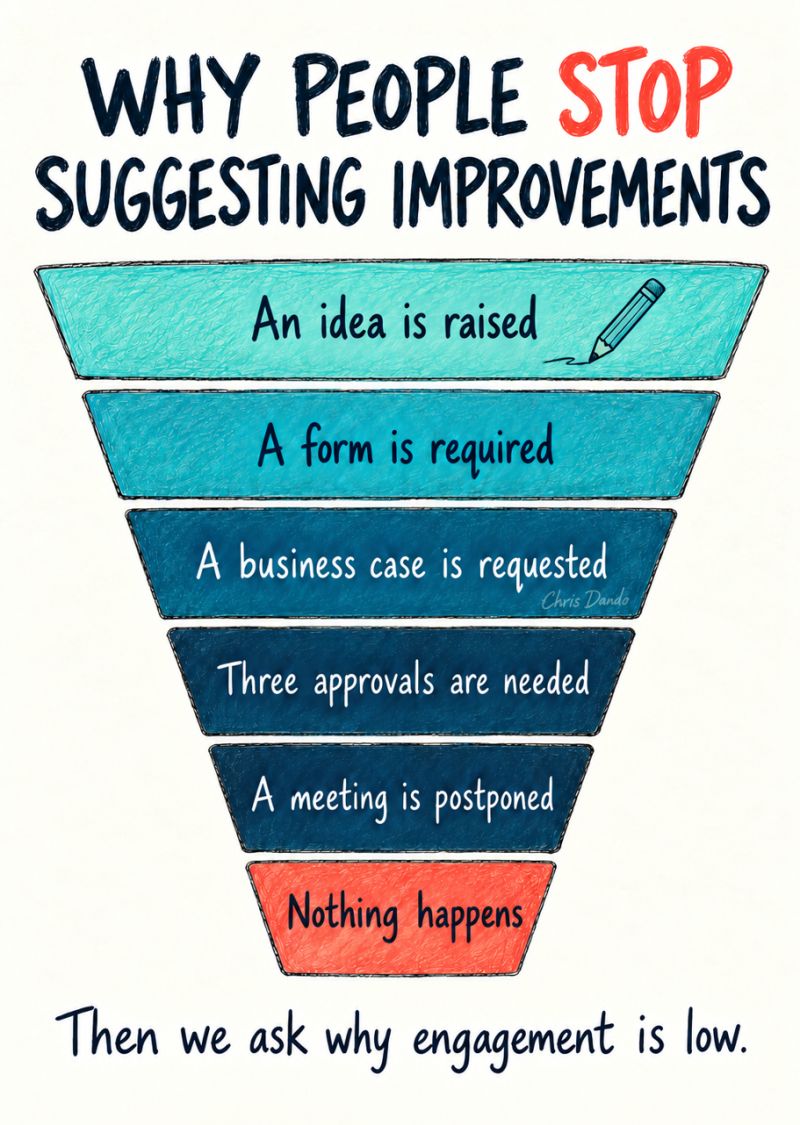
This is a sequence many people recognised: a formal submission, then a business case, followed by several layers of approval, a postponed review meeting and… nothing. Each step might be reasonable on its own, but together, they teach people that raising an idea is more effort than it’s worth.
Nobody owns the decision
Several people said the real blocker wasn’t bureaucracy but the absence of anyone willing to make a call. An idea with no owner doesn’t get rejected, but instead waits until everyone forgets it.
Credit goes missing
This one came up more than I expected. People described seeing their ideas resurface later under someone else’s name, or being quietly shelved until someone more senior could present them. Once that happens a couple of times, people stop contributing and start doing the minimum.
The system was never built to carry ideas
One commenter said people look at him strangely when he says he doesn’t like suggestion boxes. His point wasn’t that collecting ideas is wrong, but the backbone needed to make it work is badly underestimated. I agree. A suggestion box or an ideas platform can collect ideas. That’s the easy part.

Closing the feedback loop is where engagement is won or lost
If there’s one thing I’d want leaders to take from this, it’s that feedback has to run through the whole thing. Not just at the start, and not just when an idea succeeds.
In practice, closing the feedback loop means:
-
Telling people their idea has been considered, quickly.
-
Explaining why if it won’t progress because an honest no is far better than silence.
-
Involving the person who raised it in testing it.
-
Checking whether the change helped, whether it lasted and what others can learn from it.
-
Making sure the right person gets the credit.
Every ignored suggestion teaches someone that speaking up is a waste of time. Every idea that’s acknowledged, tested and talked about teaches the opposite.
Make small changes easy to test
However, not every idea needs the same route. Small, low-risk, reversible changes should be straightforward to test, often by the people who raised them. Bigger changes need the right scrutiny, methodology and expert support.
One of the strongest points in the comments was that engagement rises sharply when the first question asked is “how could we test that?” rather than “can you write that up?” Decisions get made closer to where the knowledge is, and people see their ideas turn into something real.
This however doesn’t mean removing controls. Safety, quality, regulatory compliance and significant financial risk still need proper governance. The goal is proportionate governance, so a tweak to a workstation layout isn’t treated like a capital project.
Look at the improvements you can’t see
Another comment made me think deeper about the informal improvements that happen within organisations. When formal routes are slow or unproductive, people don’t stop improving things, instead they work around the system instead.
Some of those informal fixes are genuinely valuable, whilst others hide problems or create dependencies nobody fully understands. Either way, they tell you a lot about how your organisation really works. Alongside asking what happened to the ideas people submitted, it’s worth asking what they’ve already changed without asking.
Why the CI operating system matters
This is one of the many reasons I built OpX. Most organisations don’t lack ideas or enthusiasm. What they lack is the operating system that sits behind continuous improvement and carries an idea all the way through to a sustainable change.
That means a clear route from idea to tested change, with:
-
Ownership, so every idea has someone responsible for the next step.
-
Time and capacity to actually do the work.
-
Clear decisions, made at the right level.
-
Visibility, so people can see where their idea is and what happened to it.
-
Support to make the change stick once it’s been made.
A strong kaizen culture isn’t measured by how many ideas people submit. It shows throughout how consistently the organisation listens, acts and learns. That’s also why I’d measure response times, implementation and actual improvements, not just the number of suggestions collected.
A simple test for your organisation
Before you launch another call for ideas, try this. Take the last three ideas raised by frontline colleagues and follow them through your organisation.
Where did each one go? Who looked at it? Was a decision made, and was it explained? Did the person who raised it hear anything back?
You’ll learn a lot about whether people are likely to offer a fourth.
Frequently asked questions
Why do employees stop engaging with continuous improvement?
Usually because experience has taught them nothing happens. Ideas go unanswered, decisions aren’t made or explained, and credit doesn’t always reach the person who raised the idea. Engagement drops because belief drops, not because people run out of ideas.
How do you improve continuous improvement engagement?
Start by fixing what happens after an idea is raised. Respond quickly, give every idea an owner, let people test small changes themselves, explain decisions honestly and share what was learned. Engagement follows when people see their ideas go somewhere.
Do suggestion schemes work?
They can collect ideas, but on their own they rarely sustain engagement. Without ownership, decisions, time to act and feedback, a suggestion scheme becomes a place where ideas go to wait. The system behind it matters more than the box itself.
What does closing the feedback loop mean in CI?
It means the person who raised an idea hears what happened to it at every stage: that it was considered, whether it’s going ahead and why, how the test went, and whether the change lasted.
What is a CI operating system?
It’s the structure that carries improvement work from idea to sustained change: routes for different sizes of change, clear ownership, governance that matches the risk, visibility of progress and feedback built in throughout. OpX is built to be that operating system.
If you want to see how OpX helps organisations turn frontline ideas into tested, sustainable improvements, request access here.